
Cross-posted with the MIT Picower Institute.
Democracy is for certain a crowning achievement of human minds, but far less certain is how studies of the brain and mind could help efforts to improve the functioning of democracy. The May 19 symposium “The Neuroscience of Democracy” at The Picower Institute for Learning and Memory at MIT, brought neuroscientists, social scientists and civic leaders together to build conceptual bridges between brain research and public affairs.
“We don’t typically consider how the brain is not only the basis of ourselves, but also the basis of our societies,” acknowledged Picower Professor of Neuroscience and Picower Institute Director Li-Huei Tsai in her opening remarks. “Our institutions are our creations and our participation in them is our choice. They emerge from, and are sustained by, our needs, our cognition, our beliefs, and our behavior.”
More than 300 people registered to attend the event, organized in collaboration with The Freedom Together Foundation (FTF), a charitable foundation that works to create a more democratic, inclusive, and sustainable society and supports The Picower Institute. The Picower Institute was established in 2002 with a gift from Jeffry and Barbara Picower.
Debunking the “rationalist fallacy”
Several speakers who’ve spent their careers working on civic issues in communities around the United States emphasized that democratic participation, whether that means voting or engaging in movements and campaigns, stems at least as much from emotion as from a rational calculation of self-interest.
Before he became FTF’s President, Deepak Bhargava was teaching at the City University of New York where his research asked how democratic movements could engender as strong an emotional attachment as authoritarian movements seem to do. Central to this work, he said, is a need to critique a “rationalist fallacy” that pervades public affairs analysis. Bhargava said that after years as a community organizer where he’s seen the importance of emotion and a sense of group belonging, he’s routinely surprised by the shock of others that citizens sometimes seem to vote against their own financial interests.
“This way of viewing people and their motivations is an obstacle to understanding and engagement with them and it’s predicated on an economistic model of understanding human motivation that is just wrong,” he said.
In her keynote presentation, an on-stage dialogue with FTF Senior Fellow Felicia Wong, voting rights advocate and author Stacey Abrams recounted the multifaceted role of emotion throughout her 2018 gubernatorial campaign in Georgia. Her inspiration to run was the rage she felt when as minority leader in the state’s House of Representatives she couldn’t stop the state legislature from enacting a set of tax policy changes that she found regressive. But Abrams also said her success in motivating hundreds of thousands of potential voters who either had not felt inspired to register or to turn out if they were, derived from appealing to a more positive emotion: a feeling of possibility. More than trying to change anyone’s political beliefs, she said, the campaign sought to broaden voters’ perspectives.
“By my very presence I was proof of a different way to think about the world,” she said. “I connected that to their lived experience and I met them where they were.”
In her own keynote later in the day, Alicia Garza, FTF Senior Vice President for Movement Infrastructure and Explorations, described the central importance of hope in civic engagement. Referencing life-and-death anecdotes from the Civil Rights Movement of the 1950s and 1960s, to the Black Lives Matter movement she co-founded, to civic action in Minnesota last year, Garza said the common thread that maintained people’s courage was hope.
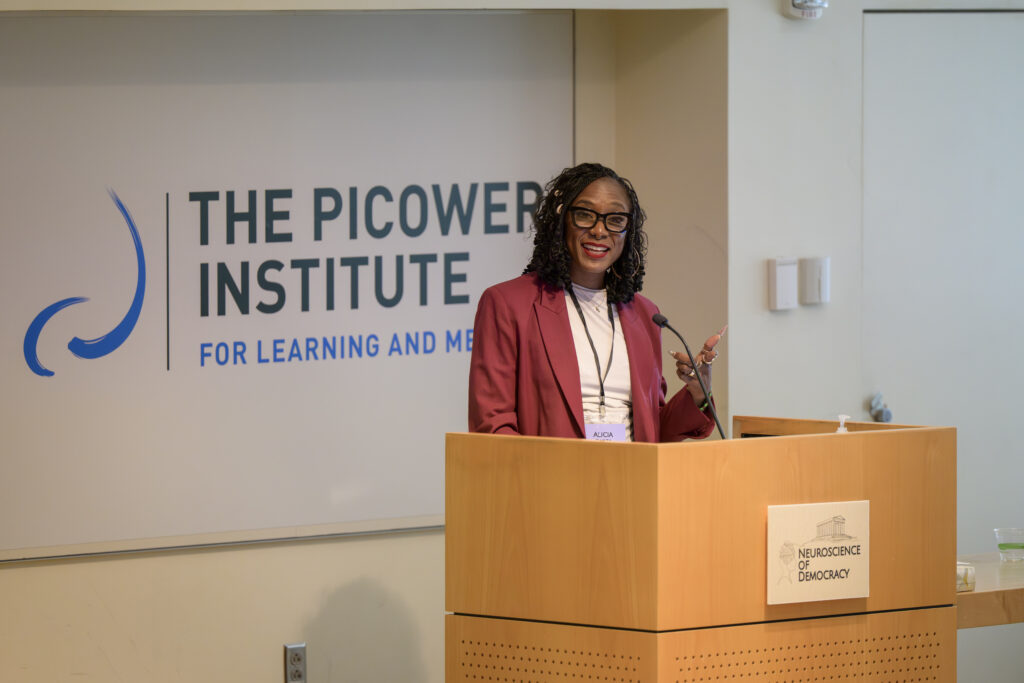
Alicia Garza delivers her talk “The Politics of Hope.”
“One of the things we know from studies of social change long-term is that oftentimes, yes, people come into protests or movements because they’re angry about something, but that does not sustain them,” Garza said. “What sustains them is hope.”
In her work as a Harvard political science professor and democracy advocate, Danielle Allen, too, said she’s seen the importance of emotion in the electorate. Allen described her research showing that half the states (blue and red ones alike) in the country doubly disenfranchise voters via closed primaries with limited competition among candidates. Notably, in his talk, Princeton neuroscience professor Sam Wang pointed out structural problems in elections—particularly gerrymandering—mean that in 90 percent of Congressional districts a primary is perhaps the only competitive election.
Part of restoring the function of democracy, Allen said, is reconnecting voters to a sense of agency, encouraging them to “multitask” so that they take on civic engagement as well as the normal activities of their daily lives, and to enhance their ability to build bridges and coalitions with unfamiliar people. She called for neuroscience research that could provide fundamental understanding of such emotions and cognition to advance those efforts.
Learnings from the labs
Indeed, several of the symposium’s neuroscientist speakers shared ways in which their research is beginning to speak to the issues the civic leaders and social scientists raised.
Tali Sharot of University College London and MIT’s Brian and Cognitive Sciences (BCS) Department presented several studies from her lab showing that (as Bhargava said) people will sometimes prioritize feelings of affinity over objective information and their own rational self-interest. For instance, in her talk “Cognitive Obstacles to Truth,” she showed that people performing a task (and being rewarded for accuracy), would preferentially ask for help from people shown to have the same political leanings over people who were actually performing the task better. To try to dispel such confirmation biases in the online sphere, Sharot’s lab is experimenting with technology that objectively labels websites via a browser plugin to rate their information quality, sentiment and instrumental utility.
In her talk, BCS Professor Rebecca Saxe addressed a theme Abrams raised: democracy doesn’t require people to agree on everything. Saxe discussed how more than a decade ago labs began studying brain activity patterns underlying empathy but said she now realizes that what would better serve studies of democracy is not cases in which people share the same feelings (“empathy”), but instead where people attempt to understand what others think (“respect”). She presented data from fMRI studies showing that the brain regions involved in considering the thinking of others are independent than the regions involved in empathy.
Emily Falk of the University of Pennsylvania noted that a crucial behavioral tool people have to bridge differences is conversation. Her research on improving conversation for civic engagement dovetailed with several themes of the day. For instance, she cited research showing how differing political backgrounds shapes neural responses to the same media and discussed several specific neural correlates of activity associated with willingness to engage in discussions of policy issues. Her research has helped her lab study when conversations can be most engaging. Strangers and friends alike enjoy conversation more when they explore new ground together. And in negotiations, her lab has found, they will do that more when they are instructed to compromise than to persuade.
A role for technology
Given the sheer scale of the electorate, many democracy researchers are considering how and whether artificial intelligence technologies can help facilitate dialogue and overcome misinformation.
MIT political science Professor Lily Tsai, for instance, described her lab’s work harnessing AI large language models to facilitate engaging virtual spaces for political dialogue. Importantly, as in a physical town meeting, participants retain the agency and freedom to become as involved as they want to be—they can engage directly in the debate (talking in the square) or they can merely observe generated overviews and summaries (looking down from a balcony). Accounting for how people want to engage, and using AI to facilitate that, can potentially improve the quality of debate over what plays out in current social media. But, as Allen did, she called on neuroscientists to help.
“Neuroscience has a lot to tell us about the kinds of signals and stimuli that make people more likely to experience a sense of safety rather than threat in an environment with unfamiliar people or people with opposing views,” she said. “It might also help us understand the kinds of stimuli and environments that make people more likely to experience a feeling of autonomy and control, and what makes people more likely to view difference with curiosity and respect.”
In his talk, MIT Political Science colleague Adam Berinsky discussed his research into combatting misinformation that erodes trust in important institutions. It’s not necessarily easy to dissuade someone who has become dug in to a belief in a conspiracy theory, he said, but he’s finding that AI-powered tools can successfully engage people in productive one-on-one dialogues. Even so, he cautioned, attitudes toward AIs can shift, so it’s possible people could begin losing trust in tools that use them.
Earl Miller discusses how the brain produces thought, and does so more efficiently than AI.
However AI is used, said Picower Professor Earl K. Miller, it would be far less disruptive to the environment and to communities grappling with the presence of massive data centers if it actually worked more like the brain does. In his talk, Miller described how the brain manages on a mere 20 Watts of power to achieve greater intelligence than AI. The brain controls its billions of connected neurons to produce consciousness and cognition with traveling waves of electrical activity, he said. The brain therefore engages in very efficient analog computation, he said, whereas AIs rely on much more energy-intensive digital computation. He called for sustained funding of basic science research, noting that it has not only helped him explain how biological intelligence works but also highlight how AI could work better.
In concluding remarks, the Picower Institute’s incoming director Myriam Heiman noted that democracy and scientific discovery historically have thrived together in cultures that value qualities such as openness to new ideas and evidence and tolerance for dissent. She said she drew hope from how the symposium highlighted ways in which efforts to strengthen democracy can draw on neuroscience.
“Understanding how people think, connect, fear, trust, learn and cooperate may help us design institutions and cultures that better align with the realities of human behavior rather than some idealized assumption about it,” said Heiman, John and Dorothy Wilson Professor at MIT.
Photos by Faith Ninivaggi.