
On April 30, 2026, MIT’s Social and Ethical Responsibilities of Computing (SERC) hosted its third annual MIT Ethics of Computing Research Symposium. The event featured a slate of speakers examining contemporary challenges and the social impact of AI. Virgile Rennard, MIT GOV/LAB Postdoctoral Associate, leads the AI for Democracy Reading Group, whose work was featured in a series of posters during the event.
The Reading Group presented four posters spanning LLM behavior in political contexts, AI governance, and civic accountability:
The Deliberation Gap: Deliberation, Partisanship, and Citizen Representation in Large Language Models
Anji Zhang (MIT Chemistry)
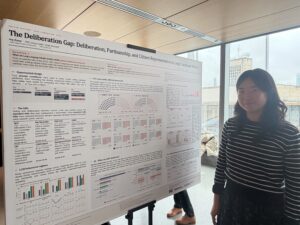
This project examined the deliberative qualities of Large Language Models and their potential to better represent U.S. citizens’ public opinion. The study tested how LLMs respond to progressively richer information environments: starting from a bare bill summary, then adding full bill text, party positions, and finally debate transcripts sourced from either Congress or LLM-generated deliberation. The eight bills were selected to vary along two key dimensions, technical complexity and value-ladenness, with a subset specifically chosen because Senate outcomes fell along strict partisan lines while external polling showed substantial cross-party citizen agreement, making them ideal stress tests for partisan versus deliberative behavior.
Testing three models across four prompt conditions, the study found that genuine deliberation is rare: on most bills, adding congressional debate text barely shifts model votes beyond the party-cue baseline. A key finding is the distinction between “senator” and “citizen” role framing: the senator frame tracks Senate roll-call outcomes closely, while the citizen frame better reflects public opinion. To test real-world implications, an experiment was run as a human study in which participants were asked to debate an LLM holding an opposite-party view on the affordable care act, with the LLM prompted to behave either as a senator or as a fellow citizen holding an opposing view. The citizen-framed condition produced greater opinion movement and warmer cross-partisan feelings, suggesting that role framing carries meaningful consequences for how AI tools are designed and deployed in civic and deliberative contexts.
Defaulting to Latent Heuristics: A Hierarchical Study of LLM Biases in Synthetic Polling
Mohamed Abdelmeguid (MIT)
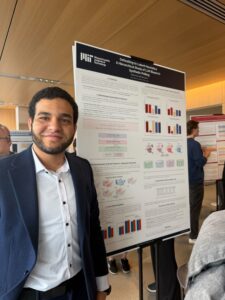
With polling costs rising for institutions and survey fatigue growing among citizens, LLMs have attracted significant interest as tools for simulating representative demographics and generating synthetic identities for opinion research. Yet the quality and reliability of these systems remain poorly understood, particularly at sub-national scales. While most synthetic polling work targets national-level predictions, far less attention has been paid to whether LLMs can faithfully reproduce electoral behavior at the municipal or precinct level, where demographic configurations can sharply diverge from state-level stereotypes.
This project investigated whether LLMs accurately weight intersecting demographic variables when simulating local electoral behavior, or whether they default to geographic stereotypes baked into their training data. The core challenge is intuitive: how hard is it for an LLM to correctly predict that a majority-Democrat precinct is Democrat, if it happens to be in Wyoming? Using an adversarial “state swap” design that held all precinct-level demographics fixed while altering only the state label, the study found that models are highly susceptible to context contamination: geographic labels alone shift predicted vote shares substantially, independently of the demographic inputs provided.
Within a fixed state context, the project further probed the strength of individual demographic biases through systematic sweeps, gradually increasing a precinct’s diversity, education level, or median income to measure how extreme a demographic profile must become before the model overrides its geographic prior and arrives at the correct prediction. Across models, the results reveal a hierarchy of influence in which broad geographic and racial stereotypes consistently overwhelm finer-grained local economic and educational signals. The work raises important questions about the auditability and governance of synthetic polling tools that are increasingly embedded in civic technology and political forecasting pipelines.
From Harm to Coverage: Government-Backed Insurance for Accountable AI
Woods Windham and Maria Santos (MIT)
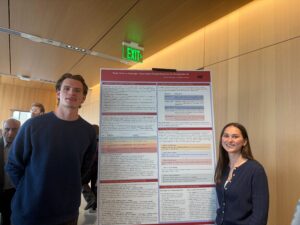
As AI systems increasingly inform high-stakes decisions in healthcare, criminal justice, financial lending, and autonomous transport, a fundamental question remains unresolved: who is responsible when they cause harm? Current tort law struggles to answer this cleanly, AI-related harm rarely emerges from a single point of failure, but from a chain of decisions distributed across data providers, model developers, and deployers, making causation difficult to prove and liability difficult to assign. Victims meanwhile face asymmetric access to technical expertise and legal resources, creating systematic underinsurance of AI-related risk.
This policy poster proposed a structured solution: a mandatory, risk-tiered insurance regime modeled on the Price-Anderson Nuclear Industries Act, which resolved an analogous uninsurability problem for nuclear power in 1957. The framework defines four tiers of AI risk, from narrow automation with human oversight to systems capable of mass harm at critical infrastructure scale, with insurance requirements, audit obligations, and incident reporting duties calibrated to each tier. For the most catastrophic-risk systems, private coverage is supplemented by an industry-funded compensation pool backed by a government guarantee of last resort, ensuring victims are not left without recourse if a firm becomes insolvent following a large-scale failure.
This project argues that actuarially priced premiums create continuous financial pressure to invest in safety, not just at the pre-deployment stage. Shifting the burden of disproving causation to insured firms, rather than requiring victims to establish it, produces a more equitable and efficient accountability system than tort litigation alone. The poster grounded the proposal in three recent U.S. cases that have already begun parsing AI liability across deployers, data curators, and model developers, illustrating both the urgency of the framework and the legal precedents it could build upon.
OpenAudit: Strengthening Governance Research & Accountability with AI-Processed Audit Reports
Jerik Cruz, Uriel N. Galace, Dr. Randy Tuaño, Ilkka Ruso, and Prof. Heidi Mendoza
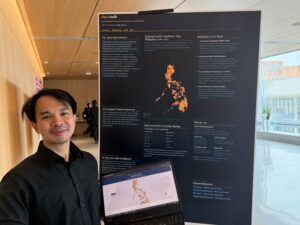
In many developing democracies, independent audit institutions regularly publish reports tracking how governments raise, allocate, and manage public resources. Despite their potential value for governance research and accountability advocacy, these reports remain largely inaccessible: voluminous, unstructured, and locked in PDF formats that are difficult to process at scale. The Philippines’ Commission on Audit (COA) has published more than 30,000 annual audit reports since 1998, among the largest and most comprehensive series of its kind in the developing world, yet until recently this evidence base was effectively invisible to researchers, journalists, and civil society.
OpenAudit is an academic–civil society initiative that directly addresses this gap, applying NLP and machine learning to extract, structure, and aggregate data from COA audit reports into a searchable, analyzable public resource. A compliance scoring pipeline classifies municipalities by the proportion of COA recommendations they have implemented over time, and an interactive map visualizes governance risk across the country, enabling both granular local analysis and national-scale comparisons. The project was recognized as the MIT Open Data Prize Winner for 2023.
Next steps include expanding the pipeline to the full national corpus spanning all 30,000+ reports, launching a fully featured public web platform with enhanced visualizations, and deepening engagement with development and policy partners including the World Bank and IATF-SAS to translate the evidence base into concrete governance reform efforts.
Read more about this project in our interview with Jerik Cruz.
Photos by Virgile Rennard
Header Image by Steve A Johnson on Unsplash